
Karnataka High Court Declares Arrest of Kodagu Homestay Owner Illegal in U.S. National Rape Case, Awards ₹5 Lakh Compensation

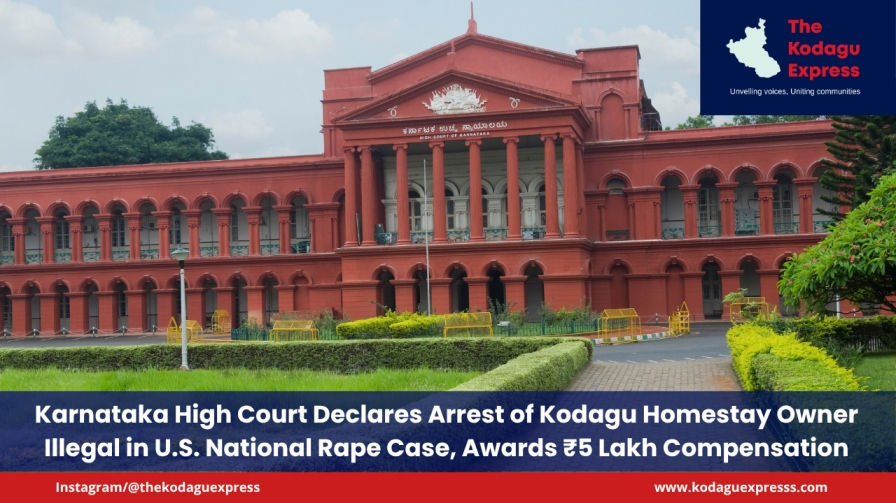
Bengaluru: In a significant ruling reinforcing the constitutional protection of personal liberty, the High Court of Karnataka has declared the arrest of a Kodagu homestay owner illegal in connection with the alleged rape of a 33-year-old U.S. citizen at his property earlier this year. The court also directed the State government to pay the owner ₹5 lakh as compensation for the unlawful deprivation of his liberty.
Justice M. Nagaprasanna passed the order while partly allowing petitions filed by the 55-year-old owner of a homestay located in Kutta, Kodagu district, according to a report in The Hindu.
The case relates to an incident in April 2026, when a U.S. national allegedly visiting the homestay was raped by a housekeeper employed at the property. While the housekeeper was accused of committing the offence, the homestay owner was subsequently arrested by the police on allegations including causing disappearance of evidence, failure to provide information about the offence, and criminal intimidation.
However, the High Court observed that the offences initially invoked against the owner were non-cognisable in nature and that there was no material available to justify his arrest. The court noted that the owner was not present at the homestay when the alleged crime took place.
In a strongly worded judgment, Justice Nagaprasanna said the arrest amounted to a violation of the petitioner's fundamental rights under Article 21 of the Constitution of India, which guarantees the right to life and personal liberty.
"The arrest of the petitioner stands as a glaring affront to Article 21 of the Constitution of India. By such unlawful deprivation of liberty, the petitioner was not merely detained; he was subjected to indignity, humiliation, and the trauma that inevitably accompanies the coercive arm of the State being unleashed without lawful justification," the court observed.
The court further found fault with the manner in which the police handled the case. It noted that after arresting the petitioner without sufficient material, the investigating officers later invoked Section 3(5) of the Bharatiya Nyaya Sanhita (common intention) only while seeking his custodial interrogation before the magistrate. The court also observed that the petitioner was not even served the grounds of arrest, making the arrest procedurally illegal.
Addressing the argument that the police had acted following communication from the U.S. Consulate regarding the incident, the court made it clear that such communications cannot override the constitutional rights of Indian citizens.
"Merely because the Embassy of the United States of America or any other country would communicate a complaint to the investigating agencies of this Nation, it would not mean that the fundamental rights of the citizens of the Nation should be bartered away," the court observed.
Besides declaring the arrest illegal, the High Court directed the Karnataka government to pay the petitioner ₹5 lakh within four weeks as constitutional compensation. The court clarified that this compensation does not prevent the petitioner from pursuing additional damages before a competent civil court.
"The present compensation is but a constitutional acknowledgement of the wrong suffered; it neither exhausts nor extinguishes the petitioner's remedies in private law," the order stated.
In a separate petition filed by the homestay owner, the High Court also stayed further criminal proceedings arising from the chargesheet filed against him and two others. The court directed the police to serve notice of the petition to the complainant through email, noting that she had already returned to the United States.
The chargesheet had invoked Section 239 of the Bharatiya Nyaya Sanhita relating to failure to inform police about an offence, along with provisions of the Foreigners Act, 1946. However, the petitioner's counsel, Angad Kamath, argued that the Foreigners Act had already been repealed and that the owner could not have informed the police about an offence of which he had no prior knowledge.
The matter will be taken up by the High Court in connection with the challenge to the chargesheet, while the stay on further proceedings against the homestay owner remains in force.
If you appreciate our work, please consider supporting us with a donation. You may contribute via Google Pay, PhonePe or Paytm at: 9980855901
To advertise on The Kodagu Express website, kindly call us at 9108795369 or mail us at thekodaguexpress@gmail.com
Join The Kodagu Express WhatsApp Group: CLICK HERE
Follow us on Instagram and X(Twitter)


Comments